 St. Petersburg Window
 Roser Park's Older Homes Face a Different Repair Puzzle
Roser Park is one of St. Petersburg's older platted neighborhoods, known for its rolling, ravine-cut terrain and a mix of early-1900s bungalow and craftsman-style homes. A house that old has usually been touched more than once — original wood lap siding in one section, a vinyl or engineered-wood patch from a decade or two back in another, sometimes two or three materials meeting at the same corner. That history matters. A siding repair here rarely starts with "replace the damaged board." It starts with figuring out what's actually on the wall, what's behind it, and whether the last repair is the reason the current one is needed.
We work on homes like these regularly, which means we're used to reading a wall's history before we touch it. That's a different skill than showing up with a truck full of one product and matching it to whatever's there.
What Pinellas County's Climate Does to Siding
Siding in St. Petersburg takes a beating that siding in a drier, milder climate never sees. A few of the mechanisms we see over and over:
- Hurricane-force wind: repeated gusts work fasteners loose and lift panel edges, especially where a prior repair used the wrong nailing pattern or spacing.
- Intense, year-round UV: south- and west-facing elevations bake in direct sun most of the year, which breaks down paint film and dries out untreated wood far faster than it would up north.
- Wind-driven rain: storms don't just fall straight down here — rain gets pushed sideways into seams, trim joints, and corners that were never built to shed water from that angle.
- Salt air: proximity to the Gulf and Tampa Bay accelerates corrosion on fasteners and metal flashing, which is often the hidden cause of a repair that looked fine on the surface a year ago and isn't now.
None of this is unique to Roser Park, but it's a big part of why a repair that would hold up for fifteen years in a milder climate might fail in three here if it's done with the wrong material or the wrong technique.
Signs a Roser Park Home Needs Siding Repair, Not a Full Replacement
Most siding problems don't require tearing off the whole wall. Repair is usually the right call when damage is localized and the framing underneath is still dry. Here's what we look for on a first visit:
- Soft or spongy spots when you press on a board, especially near the bottom courses or under windows
- Staining or streaking running down from a seam, corner, or trim joint
- Cracked or split boards concentrated on one wall or elevation (usually the one facing prevailing wind and sun)
- Paint that's bubbling, peeling, or chalking heavily in patches rather than evenly across the whole house
- Gaps opening up where trim meets siding, or where an old patch meets the original material
- Buckling or waviness that started right at the edge of a previous repair
- Small entry holes or soft trails at low band boards, which can point to pest activity following moisture
If the damage is confined to one or two areas and probing shows dry sheathing behind it, repair makes sense. If moisture has clearly traveled behind multiple courses or across a large section of wall, that's a different conversation — and we'll tell you honestly which situation you're in rather than defaulting to whichever job is bigger.
What a Correct Repair Actually Involves
Diagnosing Before Patching
Before any board comes off, we probe the area, check for softness in a grid pattern around the visible damage, and look at what's behind the siding where we can access it — house wrap, flashing, and sheathing condition. A repair that only addresses the visible board and ignores wet sheathing underneath is a repair that fails again within a year or two.
Matching the Material
Matching an existing profile and reveal takes more care than it sounds like. Older wood siding has a slightly different exposure and butt thickness than most modern products, and paint color on a fifteen-year-old wall has faded in ways a fresh can of "matching" paint won't replicate exactly. We're upfront with homeowners about this: a patch can blend well, but on an older home with sun-faded paint, a small color step at the repair line is sometimes unavoidable until the whole elevation is repainted.
Fastening and Sealing for Wind, Not Just Looks
The repairs that fail fastest in this climate are the ones where someone used the wrong fastener, spaced nails incorrectly, or relied on caulk to do a job flashing should be doing. We use corrosion-resistant fasteners at manufacturer-specified spacing and treat sealant as a secondary defense, not the primary one — caulk that's holding a repair together by itself will fail in coastal salt air long before the siding does.
Why We Repair — and Replace Damaged Sections — With James Hardie Fiber Cement Only
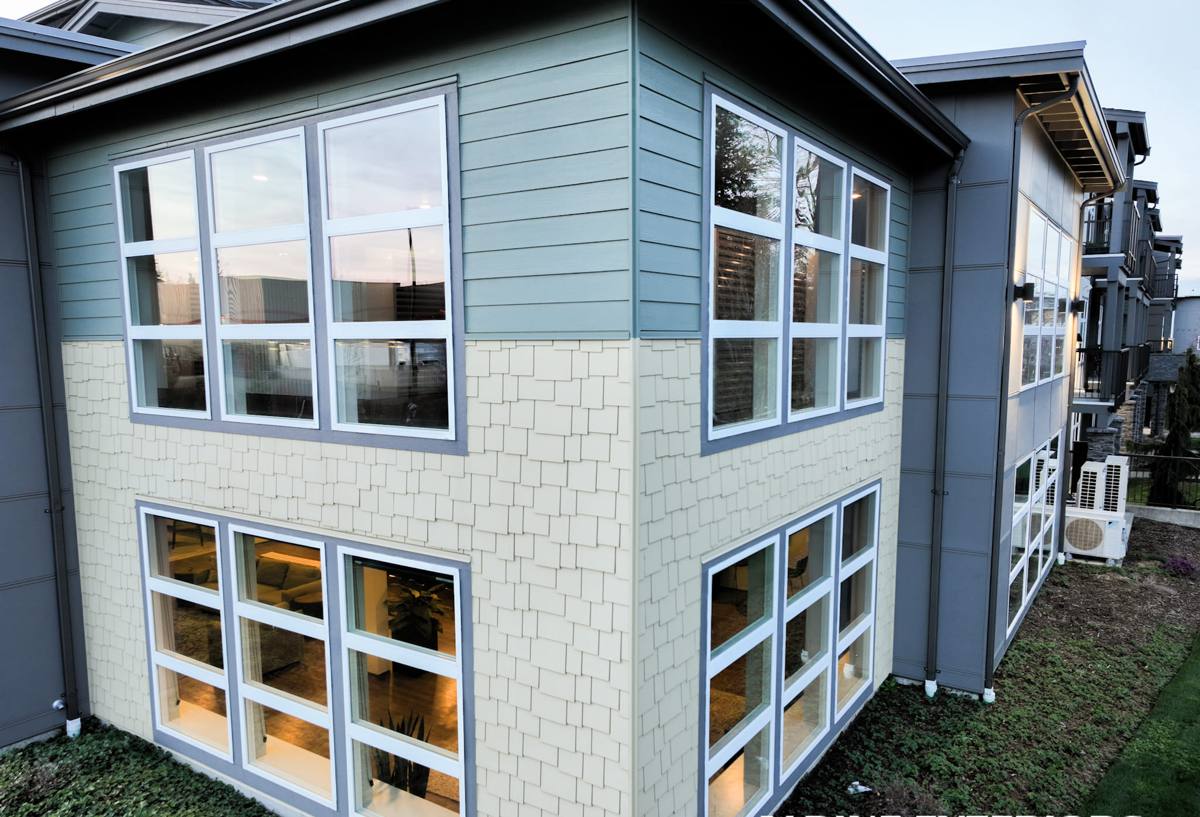
We install and repair with James Hardie fiber cement exclusively. We don't carry vinyl, LP SmartSide, Cemplank, Allura, or primed wood on the truck, and when a repair calls for replacing a section of siding rather than just patching it, we do that in Hardie as well. That's a standard we hold to because of how each of these materials actually performs over years in a hot, humid, storm-prone climate — not because the alternatives are junk.
| Material | Moisture behavior | Paint/color longevity | Fire rating |
|---|---|---|---|
| Original wood lap | Absorbs and swells if paint film fails; rot-prone at seams | Repaints well but needs frequent maintenance | Combustible |
| Vinyl | Doesn't absorb water but can warp/buckle in high heat and wind | Cannot be repainted to a durable finish; fades uniformly | Combustible, softens under heat |
| Engineered wood (LP-style) | Vulnerable at cut edges and fastener penetrations if sealed incorrectly | Good if maintained per spec | Combustible |
| James Hardie fiber cement | Dimensionally stable; engineered for moisture and humidity | Factory ColorPlus finish holds color far longer than field paint | Non-combustible |
For a coastal, hurricane-exposed county like this one, that combination — dimensional stability, a factory finish that isn't relying on field paint alone, and a non-combustible material — is why we standardized on it for every repair and replacement we do, not just new installs.
Our Process for a Roser Park Siding Repair Call
- Walk the affected area with you, probe for moisture, and check what's behind the visible damage wherever we can access it
- Give you a written scope that says plainly whether this is a repair or whether damage has spread far enough to need partial replacement
- Order matching Hardie material and, where an exact profile match isn't possible on an older home, walk you through the closest realistic option before any work starts
- Remove only the damaged sections, checking sheathing and flashing as we go
- Install with correct fastening, flashing, and Hardie-approved sealant at joints — not caulk standing in for proper detailing
- Prime and finish to match as closely as the existing paint allows
- Final walkthrough with you before we call the job done
Repair vs. Replacement: What Actually Drives the Decision
Homeowners often ask us to just quote a number before we've looked at the wall, but the honest answer is that a few factors determine whether repair is enough or replacement is the smarter long-term move.
| Factor | Leans toward repair | Leans toward replacement |
|---|---|---|
| Extent of damage | One or two isolated boards or a single section | Damage spread across multiple elevations |
| Condition of remaining siding | Rest of the wall is sound and well-attached | Adjacent boards are also failing or near end of life |
| Moisture behind the wall | Sheathing tests dry beyond the damaged area | Moisture has clearly traveled behind multiple courses |
| Material match available | Close profile/reveal match is achievable | Existing material is discontinued or badly mismatched already |
| Your maintenance plans | You're comfortable maintaining a mixed-material wall short-term | You'd rather solve it once with a uniform, low-maintenance wall |
We'll always tell you which side of that table your house is on, in plain terms, before we recommend a scope of work.
Why a Crew That Already Works Roser Park Matters
Older neighborhoods like this one reward local familiarity. A crew that's already worked on homes with the same era of construction knows what's typically hiding behind the siding before the first board comes off, recognizes patchwork repairs for what they are, and has a supply relationship that makes matching materials and colors faster than starting from scratch. If your home sits within Roser Park's locally recognized historic district, exterior repair work may also need to account for the neighborhood's design guidelines — something a crew unfamiliar with the area is more likely to miss entirely. And a local crew has a reputation in the neighborhood to protect, which matters more than any sales pitch when you're deciding who gets to work on your house.
If you've got a section of siding that's cracked, soft, or letting water in, we're happy to take a look and give you a straight answer on repair versus replacement — no pressure, no upsell, just what your house actually needs. Reach out for a free estimate using the form below.